
Risk vs Reward: How Advisors Think About Investing in Pakistan
By Muhammad Abbas · · 6 min read
Between 22 April and 8 May 2025, the KSE-100 fell 12.6%. Within two days of that low, it rose 13.3%. An investor who sold in fear locked in the loss and missed the rebound; an investor who had borrowed too much might not have survived the fall at all. That is the whole risk and reward problem in under three weeks.
Advisors approach risk vs reward investing in Pakistan with a simple order of questions: what can I earn without taking equity risk, how much could this investment lose, is the expected reward big enough to justify that loss, and can this particular client live through it? The answers decide how much of a portfolio goes into shares, and which shares.
Start With the Hurdle: What Safe Money Already Pays
Every risky investment competes with a safe one. In Pakistan, the benchmark is the State Bank of Pakistan (SBP) policy rate and the market rates linked to it, such as KIBOR rates, along with short-term government T-bill yields. If a bank deposit or a money market fund pays close to that rate with little risk, a share has to offer clearly more to earn its place.
Advisors then adjust for inflation, because the real return is what builds wealth. In its 26 October 2026 monetary policy statement, the SBP raised the policy rate by 50 basis points to 12%, effective 27 October. Headline inflation was 10.3% in September 2026, according to the Pakistan Bureau of Statistics. As a simple difference, safe money was only about 1.7 points ahead of rising prices. In our view, that gap is the starting point of every allocation conversation: when safe money only keeps pace with inflation, the case for owning productive assets grows, but so does the temptation to take risks you do not understand.
Measure Risk as the Loss You Could Suffer
Volatility, the day-to-day swing in prices, is only part of risk. Advisors care more about drawdown: how far an investment can fall from its peak, and how long it takes to recover.
The PSX has a clear reference point. In its Financial Stability Review 2025, the SBP stress-tests banks against a 36.1% fall in the KSE-100, which it describes as equal to the historically highest quarterly decline in the index. In other words, a portfolio that tracks the KSE-100 has lost more than a third of its value in a single quarter before. A concentrated portfolio can lose more.
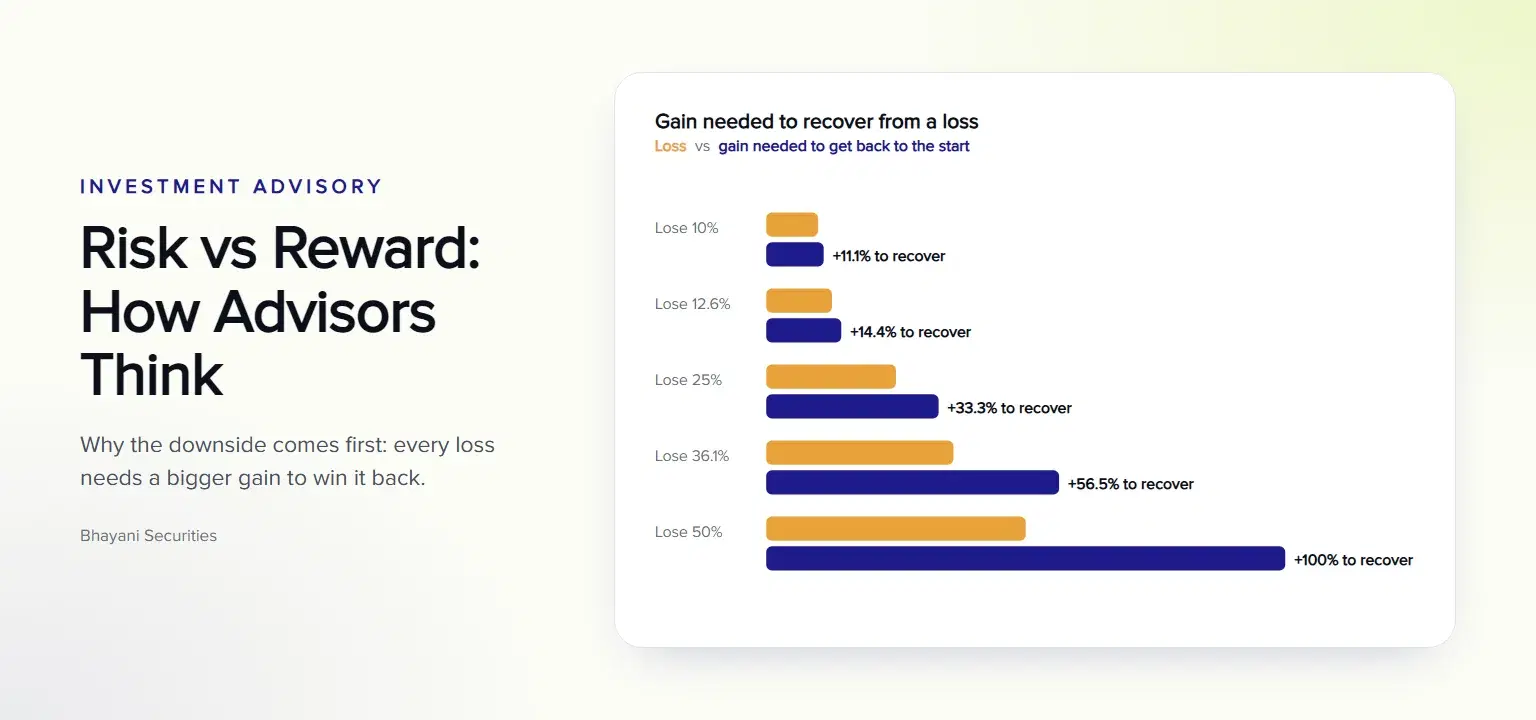
Losses also hurt more than equal gains help, because recovery is measured from a smaller base.
Gain needed to recover from a loss
| Loss | Gain needed to get back to the start |
| 10% | 11.1% |
| 12.6% (KSE-100, 22 Apr to 8 May 2025) | 14.4% |
| 25% | 33.3% |
| 36.1% (worst quarterly fall cited by the SBP) | 56.5% |
| 50% | 100% |
This is why advisors protect the downside first. A portfolio that avoids the deepest losses needs far less luck to compound. For more on how swings affect behaviour, see our guide to how volatility affects Pakistani investors.
Price the Reward: Is the Market Paying Enough?
Once the hurdle and the possible loss are clear, advisors ask whether the expected reward compensates for both. One quick check compares the stock market's earnings yield (earnings divided by price, the inverse of the price to earnings ratio, or P/E) with the policy rate.
Market earnings yield versus the policy rate
| Period | Average market P/E | Earnings yield (1 ÷ P/E) | Policy rate |
| CY23 | 4.2 | About 23.8% | 22% from 27 June 2023 |
| CY25 | 7.6 | About 13.2% | Cut from 13% to 10.5% during the year |
Source: average P/E from the SBP's Financial Stability Review 2024 and Financial Stability Review 2025 (Bloomberg data); policy rates from SBP Monetary Policy Statements.
In CY23, shares were priced so cheaply that their earnings yield roughly matched a 22% policy rate, even though shares carry far more risk than a deposit. On that snapshot alone, investors were not paid much extra for equity risk; the reward depended on rates falling and earnings holding up, which is what followed once the SBP began cutting in June 2024. The KSE-100 rose 84.3% in CY24 and a further 51.2% in CY25, according to the SBP. By then both had fallen: the earnings yield to about 13.2% and the policy rate to 10.5% by year-end, a gap of roughly 2.7 points, slightly wider than in CY23. Treat the comparison as a rough guide: the CY23 P/E is a full-year average, while the 22% rate applied only from late June, and earnings yield is not a guaranteed return.
In our view, the lesson is not that shares are expensive or cheap today. It is that the reward on offer changes with price. The same company can be a good risk at one valuation and a poor one at another, which is why advisors pair this market-level check with company-level fundamental analysis.
Match the Trade-off to the Person
Two investors can look at the same opportunity and need opposite answers. Advisors separate three things that are often mixed up:
- Risk capacity: how much loss your finances can absorb without changing your life. Money needed for a house payment in 18 months has little capacity for a 36% drawdown.
- Risk tolerance: how much loss you can watch without selling in panic. In our experience, many investors overestimate this until they see their first large drop.
- Required return: the return you actually need to reach your goal. If safe assets can get you there, extra risk adds little.
Take no more risk than the lower of your capacity and tolerance allows. If your required return needs more than that, revisit the goal or the timeline rather than the risk. Our article on how advisors build a client investment strategy explains how this profile turns into an asset allocation.
Size Every Position So One Mistake Stays Small
Even a well-priced idea can go wrong. Advisors control that by limiting how much any single stock or sector can cost the portfolio. In practice, that means position sizing based on the loss you are willing to accept, spreading money across sectors that react differently to the same news, and setting an exit plan before entering a trade.
Short-term traders often express this as a risk-reward ratio, comparing the planned loss at a stop-loss with the planned gain at a target. Our guide to risk management basics for PSX investors covers that ratio in detail. For long-term investors, the same thinking shows up as portfolio diversification across asset classes, so a bad year in equities does not force you to sell at the bottom.
Risk Reward Investing in Pakistan: An Advisor's Checklist
Before recommending how much equity risk to take, a disciplined advisor works through these questions:
| Question | What it tells you |
| What does safe money pay after inflation? | The hurdle every investment must beat |
| How much could this lose in a bad quarter? | Whether you can afford the downside |
| Is the earnings yield well above the safe rate? | Whether you are being paid for the risk |
| What do capacity, tolerance and required return allow? | How much risk suits you, not the market |
| How much can one position cost the portfolio? | Whether a single mistake stays survivable |
Risk vs reward investing in Pakistan rewards investors who answer these questions before they buy, not after the market has already moved. If you would like a second view on how much risk your own portfolio should carry, our advisory services start with exactly this conversation, and you can speak to an advisor to book one.
Disclaimer: This article is for educational purposes only and should not be treated as investment advice. Stock investments carry market risk, and investors should consult a licensed financial advisor before making investment decisions.
Frequently Asked Questions
What is the risk-free rate in Pakistan?
Investors usually treat short-term government T-bill yields, which track the SBP policy rate, as the closest thing to a risk-free return. Rates change with each monetary policy decision, so check the latest SBP statement or live KIBOR rates before comparing.
How much can the KSE-100 fall?
The SBP describes a 36.1% fall as the historically highest quarterly decline in the KSE-100. Smaller falls happen too: the index dropped 12.6% between 22 April and 8 May 2025.
Is a higher return always worth a higher risk?
No. Extra risk is only worth taking if the expected reward is large enough to compensate and if you can survive the possible loss without selling at the bottom.
How do advisors decide how much risk a client should take?
They weigh the client's risk capacity and risk tolerance and take no more risk than the lower of the two allows. If that will not reach the required return, they revisit the goal or the timeline rather than the risk.

Written by
Muhammad Abbas
CEO, Bhayani Securities (Pvt) Ltd.
Need Guidance?
Book a free consultation with our licensed investment advisors.